The vibrating dewatering screen is responsible for reducing moisture in the
quartz sand wet production line, but many customers have found that the screen
surface has serious water leakage - water does not leak out of the screen holes,
but instead flows away from the discharge end along with the sand, resulting in
a high moisture content in the finished product and a sudden increase in
pressure during subsequent drying or packaging processes. The problem usually
lies in the coordination of three aspects: feed concentration, screen
inclination angle, and screen selection.
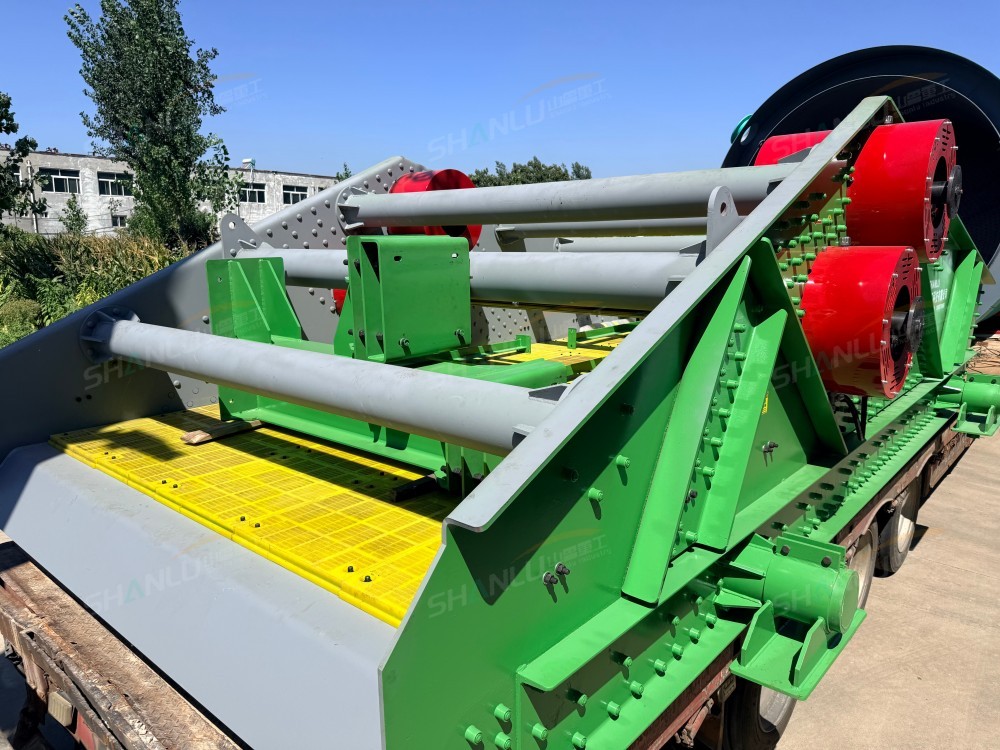
Low feed concentration is the primary cause of water leakage. When the slurry
concentration entering the dewatering screen is below 40%, the amount of water
is much greater than the amount of sand, and the screen surface cannot filter
out all the water. The excess water will overflow from the discharge end wrapped
in fine sand. The solution is to check the working status of the front-end
concentrator or cyclone, and stabilize the concentration of the screened slurry
between 40% and 55%. If there is no concentration equipment at the front end, a
small thickener or sedimentation tank can be added before the dehydration screen
to reduce the water volume before entering the screen.
Inappropriate inclination angle of the screening surface can also lead to
water leakage. When the inclination angle is too small, the material stays on
the sieve surface for too long. Although water can leak down, the processing
capacity decreases, and the material layer becomes thicker and thicker. The
bottom layer moisture is taken away before it can be discharged; If the
inclination angle is too large, the material will slide down too quickly, and
the water will be discharged with the sand before it can pass through the sieve.
It is recommended to control the inclination angle of the sieve surface between
7 ° -10 °. When dealing with coarse sand, the larger value should be taken, and
the smaller value should be taken for fine sand. Adjust by 1 ° each time,
observe the change in moisture content of the discharged material for 2 hours,
and gradually find the optimal angle.
Choosing the wrong mesh size can also cause water leakage. When the mesh size
is too large (such as 100 or more), the sieve holes are too fine and the water
discharge channels are insufficient, which can easily form a water film on the
sieve surface and cause water to follow the sand; If the mesh size is too small
(such as 20 mesh), a large amount of fine sand will be lost, and the solid
content in the screened water will be higher. At the same time, water is more
likely to escape from the discharge end. It is recommended to use a 40-60 mesh
polyurethane sieve for dehydration of quartz sand, which balances permeability
and sand interception ability. If the content of -200 mesh fine powder in the
material is high, a water blocking plate can be installed on the screen surface
to extend the residence time of the slurry on the screen surface.
During daily inspections, observe the moisture content of the discharged
material once per shift. If it is significantly high, investigate it one by one
in the order of "checking the feed concentration first, adjusting the
inclination angle of the sieve surface, and finally checking the mesh size of
the sieve". Shanlu Heavy Industry has been serving in the field of quartz sand
dewatering and screening for many years, and can provide suggestions for screen
selection and angle adjustment according to material particle size and
production capacity requirements. If the equipment encounters problems during
operation, you can contact the technical team of Shanlu Heavy Industry for
communication: Manager Zhang 13583776655 (same as WeChat).