Drum screen is commonly used in the pre grading process of quartz sand, but
after running for a period of time, the processing capacity gradually decreases,
and the same amount of feed cannot be screened, resulting in a large amount of
unfiltered fine powder mixed in the finished product. The problem usually lies
in two aspects: clogged sieve holes and cylinder rotation speed.
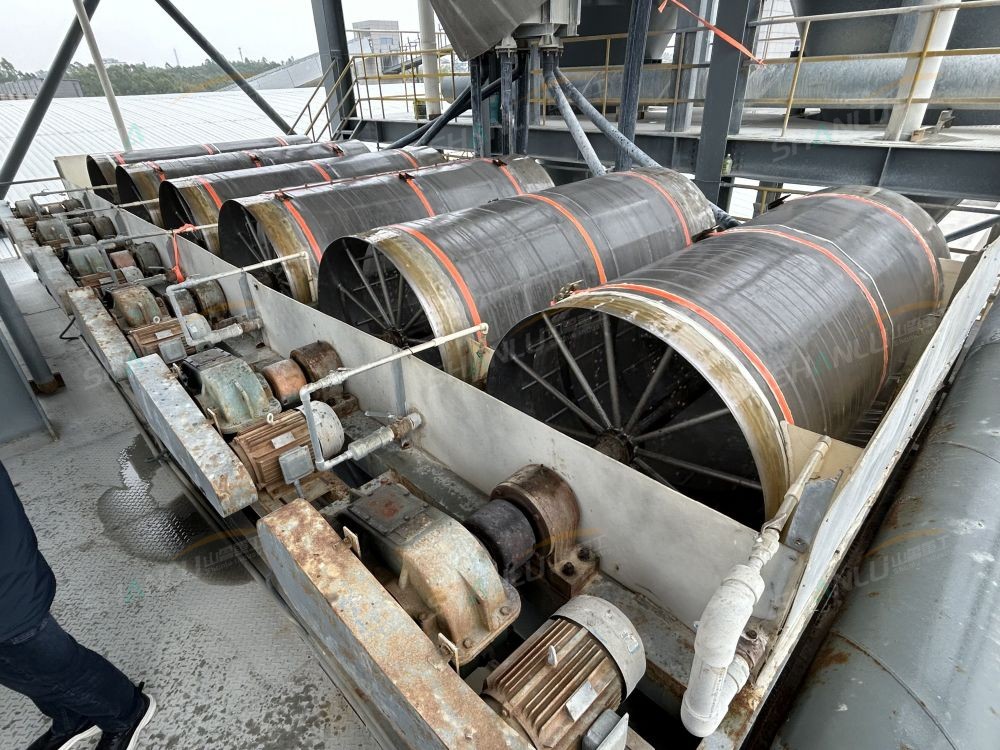
The blockage of sieve holes is the primary reason for the decrease in
processing capacity. When the moisture content of quartz sand exceeds 5%, the
fine powder adheres to the inner wall of the sieve and accumulates thicker,
resulting in a smaller effective sieve area and difficulty in material sieving.
Although the drum screen is equipped with a roller brush or scraper cleaning
device inside, the cleaning effect is greatly reduced after the roller brush
wears out. It is recommended to observe the amount of material sieved once per
shift, and stop the machine to check the sieve holes when a significant decrease
is found. Rinse the screen surface with a high-pressure water gun, keeping the
water pressure within 0.5MPa to avoid damaging the screen mesh. Replace the
roller brush in a timely manner when the length of the brush is less than half
of the original size due to wear and tear.
A low rotational speed of the cylinder can also result in an inability to
increase processing capacity. The drum screen relies on the rotation of the
cylinder to roll and advance the animal material. When the speed is too low, the
material moves slowly inside the cylinder, and the material layer becomes
thicker as it accumulates. Fine particles are carried by coarse particles and
discharged from the discharge end before they can contact the screen surface.
The normal speed is generally controlled between 12-18r/min. When processing
materials with high fine powder content, the larger value is taken, and when
coarse particles are the main component, the smaller value is taken. The speed
adjustment is completed through a frequency converter, with each adjustment of
2r/min. Observe the change in processing capacity for 2 hours before deciding
the next step.
The mismatch between the sieve size and the incoming material can also affect
the processing capacity. When the sieve size is too small, the sieving
resistance is high, and the processing capacity will inevitably decrease; If the
sieve aperture is too large, the screening accuracy will be insufficient. The
appropriate aperture should be selected based on the particle size distribution
of the incoming material. The common configuration is a three-layer sieve with
an upper layer of 20mm, a middle layer of 5mm, and a lower layer of 1mm. If
there are many sheet-like particles in the raw material, the sieve size should
be appropriately enlarged by one level to reduce the chance of clogging.
During daily inspections, record the processing capacity and particle size of
the screened material for each shift. If a continuous decrease in processing
capacity is found, follow the order of "check the sieve holes first, then adjust
the speed, and finally check the sieve hole size" for troubleshooting.
Encountering problems during equipment operation, welcome to contact the
technical team of Shandong Heavy Industry for communication: Manager Zhang
13583776655 (same as WeChat).