The vibrating feeder is the "throat" of the quartz sand production line - it
evenly feeds the material into the crusher, mill or screening equipment, and
unstable feeding directly leads to fluctuations in all subsequent processes. The
three most frequently reported issues by customers are fluctuating feed rates,
abnormal equipment amplitude, and material slippage on the tank.
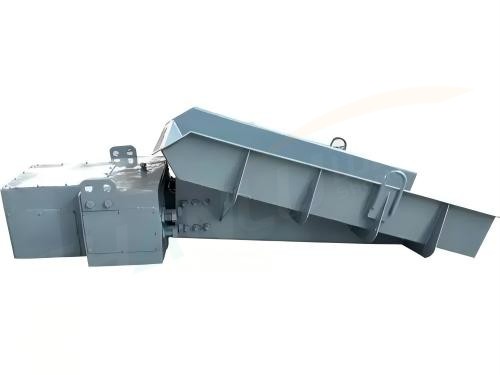
Unstable cutting, adjust the angle of the eccentric block of the vibration
motor first. The angle between the eccentric blocks determines the magnitude of
the excitation force. If the angle is too small, the excitation force will be
insufficient and the cutting speed will be slow; The angle is too large, the
amplitude is too large, and the cutting is too fast. Suggest adjusting the angle
to a position where the amplitude of the groove is between 1.5-2.5mm, depending
on the particle size and moisture content of the material - the angle can be
appropriately reduced when the particle size is coarse and the moisture content
is low; When there is a large amount of fine powder and high moisture content,
it is necessary to increase the angle to enhance the pushing force. When
adjusting, the angle between the eccentric blocks on both sides must be
consistent, otherwise the equipment will produce torsional vibration, which will
not only cause unstable feeding, but also accelerate the damage of bearings and
springs.
The aging or breakage of the spring greatly reduces the vibration effect. The
vibrating feeder relies on spring support and buffering, and the spring is prone
to fatigue aging when subjected to high-frequency vibration for a long time. The
elasticity coefficient of the aging spring decreases, the amplitude of the
equipment becomes unstable, and the feeding speed fluctuates accordingly. The
inspection method is simple: after stopping the machine, press the four corners
of the groove by hand and observe whether the rebound is uniform. If the rebound
of a certain corner is significantly weaker than that of other corners, it
indicates that the spring at that location has aged. It is recommended to
replace the spring every six months and not wait until it breaks before dealing
with it. When replacing, the four corner springs should be replaced
simultaneously to ensure consistent stiffness.
The inclination angle of the tank is unreasonable, causing material slippage
or accumulation. The installation angle of the feeder tank directly affects the
flow velocity of the material. When the inclination angle is too small, the
material slips and even accumulates and blocks in the tank; When the inclination
angle is too large, the material flow rate is too fast and the feeding amount is
difficult to control. It is generally recommended to control the inclination
angle of the tank between 5 ° -8 °, and to appropriately increase it by 1 ° -2 °
when dealing with materials with high moisture content. At the same time, check
whether the wear-resistant plate of the groove lining is worn. After the lining
is smoothed, the surface friction decreases, and the material may also slip. It
should be replaced in a timely manner.
In daily maintenance, before starting each shift, it should run without load
for 1-2 minutes to observe whether the amplitude is uniform and whether there is
any abnormal noise. If it is found that the feeding amount has significantly
decreased but the equipment is still running, it is likely that the feeding port
is stuck by large pieces of material and needs to be stopped for cleaning.
Although the vibrating feeder has a simple structure, if the parameters are
adjusted correctly, the stability of the entire production line can be improved
by one level. For issues related to equipment operation optimization, please
contact the technical team of Shandong Heavy Industry for communication and
exchange: Manager Zhang 13583776655 (same as WeChat).