The permanent magnet suspension iron remover is mounted above the belt
conveyor and is responsible for removing iron filings and bolts mixed in quartz
sand. After using it for one or two years, many customers found that the iron
suction effect was not as good as before, and the iron parts above the belt
continued to run downstream. After dismantling and testing, the magnetic field
strength on the surface of the magnet was much lower than that of the new
machine. The reason for the weakening of suction is usually due to magnetic
circuit losses and installation parameters.
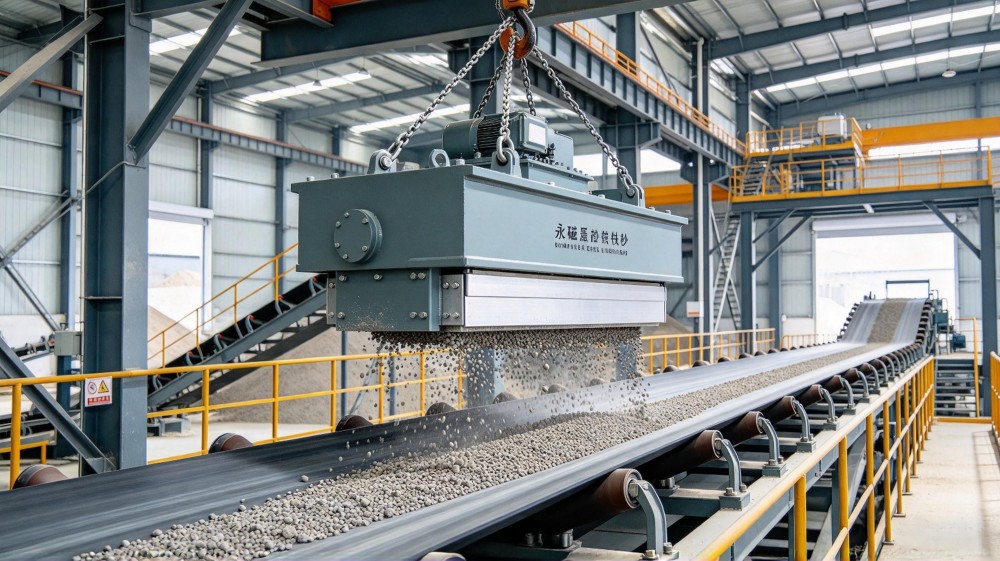
The long-term adsorption of iron filings on the surface of the magnet without
cleaning has gradually weakened the magnetic force. If the iron filings adsorbed
by the iron remover are not removed in time, they will accumulate thicker on the
surface of the magnetic pole, forming a magnetic short circuit. The magnetic
field lines are closed inside the iron chip layer, and the magnet itself is in
an overloaded state for a long time. Over time, the direction of the magnetic
domains gradually deviates. Cleaning the iron unloading port once per shift and
keeping the magnetic pole surface clean is more effective than any remedial
measures. When iron filings are found to have accumulated into blocks and cannot
be removed, it indicates that the magnetic short circuit is severe and needs to
be manually cleaned by stopping the machine.
Excessive suspension height is the most common installation issue due to
insufficient suction. The magnetic force of the permanent magnet iron remover
decays sharply with increasing distance, and the suspension height increases
from 150mm to 250mm, leaving less than 30% of the magnetic force at the bottom
of the material layer. Measure the distance from the surface of the belt to the
bottom of the magnetic pole, and control it between 150-200mm. After adjustment,
conduct a suction test on site, place several iron nuts on the belt, and observe
whether they can be sucked up. If they cannot be sucked up, it indicates that
further adjustment is needed.
The material layer is too thick, and the magnetic force of the bottom iron
parts cannot reach it. When the material layer exceeds 80mm, it is difficult to
extract the iron filings buried at the bottom. Install a flat plate or fabric
spreader in front of the iron remover to control the thickness of the material
layer within 50-80mm. When increasing the feeding amount, prioritize widening
the belt or reducing the belt speed, and do not rely on stacking high material
layers to increase production.
During daily inspections, a Gaussian meter is used to measure the magnetic
field strength on the surface of the magnet once every quarter. If it decreases
by more than 20% compared to the initial value, the seal and magnetic block
status need to be opened for inspection. Encountering problems during equipment
operation, welcome to contact the technical team of Shandong Heavy Industry for
communication: Manager Zhang 13583776655 (same as WeChat).