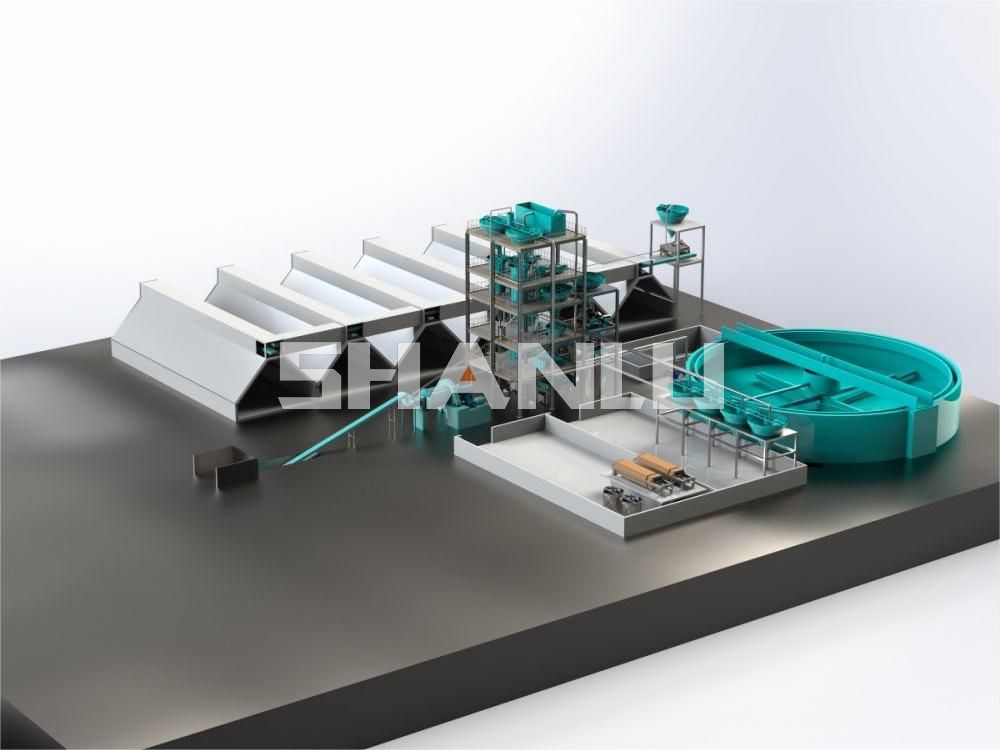
The quartz sand production line consists of multiple stages such as crushing,
screening, grinding, magnetic separation, grading, and dehydration. Any problem
in any stage may affect the yield and quality of the final product. Based on
actual feedback from frontline production, the following issues are the most
common and easily overlooked.
The screening equipment has low efficiency and the screen mesh is frequently
damaged
Screening is a key process for controlling the particle size of quartz sand.
Many companies have reported that the screening efficiency has been consistently
below 75%, and the service life of the sieve is less than 7 days. The reasons
are usually concentrated in three aspects: first, the material has a high
moisture content, and fine powder adheres to the sieve holes, causing blockage;
The second issue is uneven feeding, where the material accumulates too thick on
the screen surface and the fine particles cannot fully contact the sieve mesh;
The third issue is improper setting of amplitude and tilt angle. If the
amplitude is too small, the material movement is not sufficient, and if the tilt
angle is too small, it is easy to accumulate. When troubleshooting, it is
recommended to first measure the moisture content of the material. If it exceeds
5%, consider adding pre dehydration or adjusting the mesh aperture at the front
end. At the same time, check the angle of the eccentric block of the vibration
motor. The larger the angle, the greater the amplitude, but it is necessary to
avoid excessive damage to the equipment. It is recommended to control the
inclination angle of the screen surface between 15 ° -20 °. In terms of screen
selection, quartz sand has high hardness and strong abrasion resistance, and
polyurethane screen with good wear resistance should be selected instead of
ordinary steel wire mesh.
The iron removal effect of the magnetic separator is poor, and the magnetic
field strength decays quickly
Magnetic separation is the core process of quartz sand purification, and the
required iron content in the finished product is usually not more than 0.05%. If
the iron content still exceeds 0.1% after magnetic separation, or if the
magnetic field strength decays by more than 30% after six months of use, a
systematic investigation is required. Common reasons include: feed particle size
exceeding the equipment processing range, large particles carrying magnetic
minerals directly passing through the magnetic field zone; Excessive or
insufficient slurry concentration affects the sorting efficiency; The
accumulation of iron impurities on the surface of the magnetic roller or
magnetic plate is not cleaned up in time, which reduces the effective adsorption
area. When troubleshooting, first sample and test the particle size distribution
of the feed to confirm whether it matches the equipment design parameters.
Regular cleaning of magnetic rollers and magnetic separation tanks is a basic
maintenance requirement. If the magnetic field strength significantly decreases,
it is necessary to check whether the magnetic material has demagnetized. It is
normal for the magnetic force of permanent magnet equipment to decrease after
years of use, and replacement of the magnetic group should be considered.
The wastewater treatment of the wet production line does not meet the
standards, and the sand water separation is not thorough enough
In wet processes, the treatment of tailings slurry after scrubbing and
magnetic separation is key to environmental compliance. Many enterprises are
facing problems such as frequent equipment blockage, incomplete sand water
separation, excessive mud content in finished products, and substandard
wastewater treatment. The root cause of the problem often lies in insufficient
processing capacity of the thickener or improper addition of coagulants. If the
bottom flow concentration of the thickener does not reach 40% or above, the
subsequent feed concentration of the filter press will be too low, which will
lead to prolonged pressing cycle and high moisture content of the filter cake.
When troubleshooting, first check whether the thickener rake is operating
normally and whether the bottom flow discharge is unobstructed. The type and
dosage of flocculant need to be adjusted according to the particle size
composition and pH value of the tailings slurry, and the same formula cannot be
used for a long time. Blockage of filter cloth in filter press is also a common
cause and needs to be cleaned or replaced regularly.
The grading accuracy deviation of the classifier is large, and fine particles
are carried away and lost
Graded assignments directly affect the concentration of particle size
distribution in finished products. In actual production, classifiers often
encounter problems such as large classification accuracy deviation, screen
blockage, and fine particle entrainment and loss. In dry air flow
classification, problems are often related to imbalanced air flow control and
uneven feeding. When the air volume is too high, fine powder is excessively
extracted, and when the air volume is insufficient, coarse powder is mixed into
the finished product. In wet hydraulic grading, the rising water flow velocity
and feed concentration are key parameters that need to be adjusted in a timely
manner according to changes in incoming particle size. When troubleshooting, the
feeding amount should be stabilized first, and then the grading parameters
should be adjusted one by one to avoid complex problems caused by adjusting
multiple variables at the same time.
Frequent jamming and blockage of feeding and conveying equipment
The unstable feeding and frequent jamming of the plate feeder, as well as the
blockage and return of materials in the bucket elevator, are common auxiliary
equipment problems in the production line. Jamming is usually caused by high
moisture content or the presence of large foreign objects in the material. When
troubleshooting, first clean up the material accumulation at the feeding port
and check if there are any foreign objects mixed in. If the bucket elevator
returns a large amount of material, it is necessary to check whether the hopper
is worn or deformed, and whether the operating speed is too fast. Blockage and
shutdown not only affect production capacity, but frequent starting and stopping
can also shorten the lifespan of motors and reducers.
The investigation of production line problems should follow the principle of
"process before equipment, parameters before components". Improper equipment
selection is the root cause of many problems. When selecting, it is necessary to
comprehensively consider material characteristics, production capacity, and
finished product requirements, rather than simply pursuing low prices or large
processing volumes. Shandong based Shanlu Heavy Industry has accumulated more
than 20 years of experience in the field of quartz sand equipment, and can
provide one-stop services from equipment selection, parameter optimization to
transformation and upgrading for actual production line conditions. If the
production line encounters specific problems that require investigation and
solution, you can contact the technical team of Shandong Heavy Industry for
communication and exchange: Manager Zhang 13583776655 (same as WeChat).