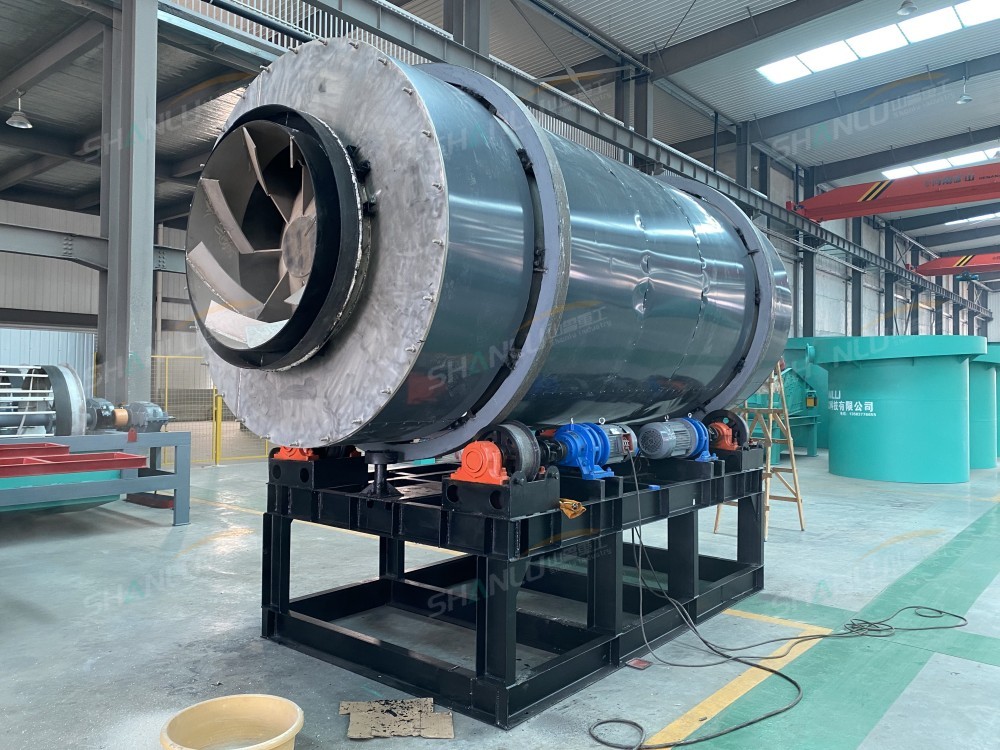
In the quartz sand drying process of the three return drum dryer, it is
common for the thermal efficiency to continuously decrease due to the sticking
of materials on the inner wall of the drum. Many customers have found that after
running the equipment for several months, drying the same amount of quartz sand
requires more fuel consumption, and the moisture content of the discharged
material is actually higher than before. The problem usually lies not in the
heat source, but in the cylinder speed and the plate structure.
Improper rotation speed of the cylinder prevents the formation of an
effective material curtain. The ideal motion state of quartz sand inside the
cylinder is "throwing", which means that after being carried to a certain height
by the plate, it falls in a parabolic shape, forming a material curtain and
fully contacting with the hot air. When the speed is too low, the material only
slides at the bottom of the cylinder, and the contact area with the hot air is
insufficient; When the rotation speed is too high, the material is tightly
pressed against the cylinder wall, and an effective material curtain cannot be
formed, and the moisture cannot be fully evaporated. It is recommended to
control the rotational speed of the cylinder within the range of 3-5 r/min. The
actual optimal rotational speed needs to be determined through experiments based
on the particle size, moisture content, and filling rate of the quartz sand.
The efficiency of drying will be compromised if the copied board is worn or
missing. When the wear of the copying board (lifting board) exceeds one-third of
the original height, the material cannot be lifted, and a large amount of wet
sand accumulates at the bottom of the cylinder to form a "dead material zone",
which not only causes uneven drying, but also accelerates local wear of the
cylinder. It is recommended to check the wear of the copied board once a month
and replace it promptly if it is severely worn. The spacing between the copied
boards is also worth paying attention to - when the spacing exceeds 200mm, the
material is not lifted sufficiently and the drying uniformity decreases. If a
large number of undried "wet lumps" are found at the discharge end during daily
inspections, it can be basically judged that there is a problem with the board
copying.
Quartz sand is prone to adsorb onto the cylinder wall at high temperatures,
increasing the risk of sticking materials. When the moisture content of quartz
sand is high, it forms a compacted layer that firmly adheres to the cylinder
wall at high temperatures. Installing a detachable wear-resistant scraper plate
on the inner wall of the cylinder is an effective method, which can clean
residual powder in real time when combined with the rotation of the cylinder. At
the same time, strictly control the moisture content of the feed to below 5%,
and add a pre dehydration process when the humidity is too high. Shutdown and
clean the inner wall of the cylinder once a week. If the adhesive thickness
exceeds 10mm, it should be dealt with promptly.
Whether the thermal efficiency of the dryer is high or not depends on whether
the cylinder speed is correct, whether the plate grinding is done properly, and
whether the adhesive inside the cylinder is cleaned. Shanlu Heavy Industry can
provide optimization suggestions for dryer parameters based on customer material
characteristics. For equipment selection and operation related issues, please
feel free to contact the technical team of Shandong Heavy Industry for
communication and exchange: Manager Zhang 13583776655 (same as WeChat).